To schedule an appointment call: 1 (800) 605-0031
Follow Us :


To schedule an appointment call: 1 (800) 605-0031
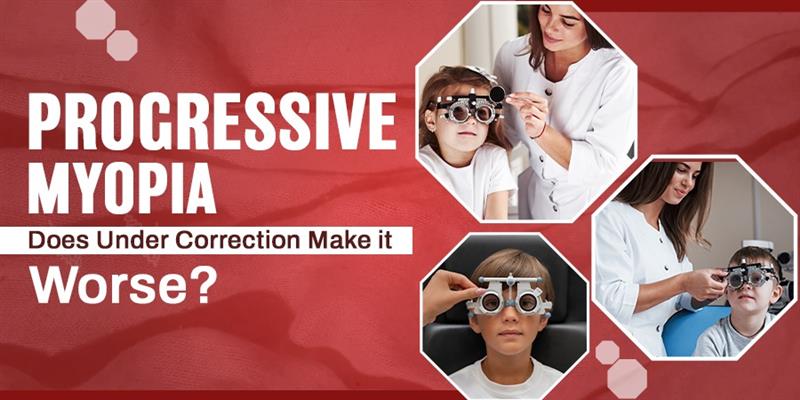
The term “progressive myopia” means nearsightedness that keeps increasing with time. If you have it, you need more powerful glasses or contact lenses, and you need to keep changing them every year. This condition usually starts in childhood and can continue through the teenage years.
Myopia rates are increasing throughout the world. In parts of East Asia, more than half of teenagers are nearsighted. The United States has also seen a steady increase in cases over recent decades.
Myopia progression matters because higher levels of myopia raise the risk of eye disease later in life. These risks include retinal detachment, glaucoma, cataracts, and myopic maculopathy.
There’s a long-standing debate in eye care: Does under-correction make progressive myopia worse? Older theories suggest weaker glasses might slow eye growth. Recent research, however, has a different story to tell. In this guide, we will tell you all about progressive myopia. We will explain what under-correction is all about and what scientific evidence shows today.
As we have already stated, progressive myopia refers to nearsightedness that keeps increasing with time. In simple words, distant objects appear blurry, while the prescription gets stronger every year.
Stable myopia stays at the same level once growth stops. Progressive myopia just worsens gradually. Things get worse during childhood and adolescence.
Doctors measure myopia in diopters. Myopia progression generally changes from 0.25 to 0.75 diopters per year in children. Eye doctors also track axial length, which means the front-to-back length of the eye. When it grows longer, refractive error increases.
Childhood myopia often progresses faster than adult myopia. Progression usually slows down in the late teenage years, but some adults keep experiencing small changes. This is true for folks with high myopia.
High myopia increases long-term risks. That’s why careful monitoring is necessary.
Myopia progression points to the rate at which nearsightedness worsens. In kids, eyes continue to grow. If axial length increases too much, light focuses in front of the retina instead of on it.
The rate of progression tends to be faster in younger children. A child diagnosed at age six has a higher risk of stronger prescriptions later compared to another child diagnosed at age twelve.
Here are a few factors that increase risk:
Uncontrolled myopia progression increases long-term risks, such as retinal detachment, glaucoma, cataracts, and myopic maculopathy. Early management reduces future complications.
The term “under-correction” refers to the process of prescribing weaker glasses than the full measured prescription. For instance, if a child measures minus 2.00 diopters, the doctor might prescribe minus 1.50 diopters.
Several years ago, many doctors believed under-correction would reduce eye strain. Their theory suggested less correction might slow eye growth. This idea led to research, including the under-correction myopia progression study trials.
Under-correction has been used more often in pediatric care than in adults because they rarely receive weaker prescriptions unless there is a specific reason.
The main question that remains is this: Does leaving some blur slow eye growth or stimulate more progression?
Clinical trials have explored this topic over the past two decades. Researchers compared fully corrected children with under-corrected children.
Several studies have found quicker myopia progression in under-corrected groups. Axial length increased in children wearing weaker prescriptions. Some studies reported almost double the progression rate compared to full correction.
Meta analyses reviewed multiple trials. None of the overall conclusions support under-correction as a treatment strategy. Evidence also suggests full correction does not worsen progression. Actually, leaving blur may signal the eye to grow longer.
Here’s what we have concluded:
Present research suggests under-correction does not slow progressive myopia and may increase myopia progression.
This takeaway has influenced modern clinical recommendations.
We are going to give you a direct answer:
Yes, under-correction can make progressive myopia worse in children.
This is what research indicates:
Most eye care professionals no longer recommend under-correction for myopia control.
Expert consensus supports full or evidence-based myopia control strategies instead of weaker prescriptions.
Today, doctors utilize various strategies to manage progressive myopia.
Full correction glasses ensure clear distance vision. Clear retinal focus may reduce signals for eye growth.
Myopia control lenses use peripheral defocus designs. DIMS lenses and other specialty lenses alter peripheral light patterns. This approach aims to slow axial elongation.
Orthokeratology, also called Ortho K, uses rigid contact lenses worn overnight. They reshape the cornea temporarily and may reduce progression rates.
Low-dose atropine eye drops show benefit in many studies. Doctors use carefully controlled concentrations for pediatric patients.
Making lifestyle changes is also important. For instance, increasing outdoor time, natural light exposure, and reducing long periods of continuous near work support eye health.
Countries like Singapore, China, and Australia have adopted national strategies to manage childhood myopia. School-based screening and public health campaigns highlight the importance of early control.
Children face the highest risk of rapid progression. During growth years, axial elongation drives refractive change.
Progression often slows around late teenage years. Some individuals stabilize in early adulthood, but patients with high myopia require continued monitoring.
Doctors generally recommend annual eye exams for kids with progressive myopia. Some even require screening every six months depending on risk.
Adults with stable prescriptions still benefit from routine exams. High myopia patients need monitoring for retinal and optic nerve changes.
There are a few patterns that increase risk:
Parents should keep an eye on their kids to monitor their visual health. Symptoms of digital eye strain, such as headaches and squinting, signal the need for evaluation.
Early diagnosis leads to better control.
Schedule an eye exam if:
Sudden vision changes require prompt evaluation. Flashes, floaters, or sudden blur may signal retinal concerns in high myopia.
Yearly exams facilitate early detection and safe management.
A1. Yes. Research shows under-correction may increase axial growth and speed up myopia progression in children.
A2. Children often progress between 0.25 and 0.75 diopters per year. Younger children tend to progress faster.
A3. Progression often slows in late teenage years. Some cases continue into early adulthood, especially high myopia.
A4. Current research supports full correction over under-correction for managing progressive myopia.
A5. Evidence based methods include full correction, specialty lenses, atropine therapy, increased outdoor time, and regular eye exams.